
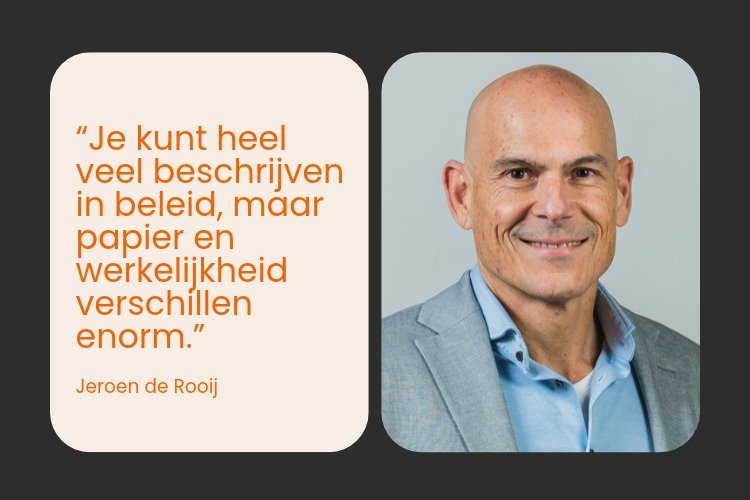
Municipalities usually have their policies in good order. There are standards, guidelines, procedures and measures. Yet that says little about how a municipality will cope when its systems go down on a Monday morning. Jeroen de Rooij has worked as a CISO at government organisations for years and keeps seeing the same pattern: there is a wide gap between paper and reality. "Cyber resilience calls for choices, not yet another document."
Plenty of policy, not enough choices
According to Jeroen, most organisations are not short on policy. The problem lies in translating it into practice. "Which processes really matter to us, and which core resources do they depend on? Which risks can we accept, and which are absolutely unacceptable? A municipality can have hundreds of security measures in place, but if nobody knows who decides when a critical service goes down, you still have a problem at the crucial moment."
That is why he believes organisations should not only ask whether they comply with all the rules, but above all whether they are truly prepared. "Technology is important, but in the end it's people and decisions that make the difference."
Why crisis preparation is different for municipalities
A municipality carries out an enormous variety of tasks, from civil affairs and benefits to public order and care. When an IT system fails, it is not just about technology, but about the teams that deliver those services. "Do they know how to keep helping residents without that system? Have they thought about the minimum resources they need? And what if an incident hits several processes at once, like the 72-hour power outage the Netherlands is preparing for? Will there be enough people to get services running again?"
On top of that, municipalities are increasingly dependent on IT service providers and software suppliers. "The municipality remains responsible for its services, but it often doesn't have the means to solve a problem itself. So who takes the initiative? Who decides which service gets priority if not everything can be restored at once? Those are questions you shouldn't be asking for the first time in the middle of a crisis."
The playbook boxes you in
Municipalities do run exercises, Jeroen observes, but often as a box-ticking obligation. "As a result, too little of it sticks. There is growing awareness that exercising matters, but it doesn't yet prepare the teams you really need when a crisis breaks out."
Part of the explanation, he says, lies in the way exercises are run. Many municipalities follow the guidance of the VNG (Association of Netherlands Municipalities). "That's helpful, because the first time round you need to learn what to think about. But it also boxes in your thinking. It doesn't help people realise what their minimum essential process is that needs to be restored, and who they need to make that happen."
His advice is to go beyond the playbook. "Sit down with the people who really know the process and start from the worst-case scenario: there's nothing at all. What do we restore first, what second and what third? What do we need to do to make that recovery happen, and what escalation paths do we have if it fails? Those are far-reaching exercises you usually won't find in a guidance document."
Start small, but start in time
What should a municipality do if it starts tomorrow? Jeroen advises starting small, with one process that really matters. "Ask yourself: what happens if this process is unavailable for three days? What does that mean for residents? Which people and systems do you need, which suppliers do you depend on, and who decides?" You also need to take an honest look at whether you can actually steer a crisis at all. A continuity plan, a recovery plan and up-to-date contact lists are the familiar basics. "But you also have to be able to say honestly to yourself: our asset administration isn't up to date enough right now, and we're going to make that a priority."
That last point is more urgent than many organisations realise, he says. Vulnerabilities are being discovered ever faster and the time to respond is getting shorter. "If you don't know which systems you have and what software runs on them, the uncertainty alone can be enough to force you to interrupt your services. A vulnerability doesn't even have to be exploited to cause a crisis." And anyone who wants to get this in order needs to start now. "If it isn't in order when it happens, you won't sort it out in a quarter of an hour. The sooner you start, the better the chance it's reasonably in order when your turn comes."
For Jeroen, cyber resilience is therefore not a task for the CISO alone. "It's about the continuity of the organisation. That's why it belongs with directors, managers and process owners. Specialists can advise and support, but you exercise together. Ultimately, that's how you build the ability to act together, and that's what cyber resilience is all about."
About Jeroen de Rooij
Jeroen de Rooij is an interim CISO and senior information security officer at Sound, a consultancy for organisations in critical infrastructure. He began his career as an IT auditor at EY and now works mainly for government organisations. Until April 2026 he was interim CISO at the municipality of Hellendoorn.